ADArsenios DiamantakosApplied AI Implementation & Software Engineering
Back to project library

Computer vision release boundary

ViT ML Delivery Proof

Public RepoML DeliveryEval ArtifactsFastAPIStreamlit

This project packages a compact ML delivery path around ViT fine-tuning and inference. It includes Oxford-IIIT Pet binary dataset preparation, deterministic training metadata, evaluation JSON, confusion matrix output, release checksum manifests, CLI prediction, FastAPI serving, Streamlit UI, checkpoint-readiness reporting, and model/evaluation templates while keeping datasets and model weights out of version control.

What it proves

Shows ML delivery packaging beyond notebooks: public dataset preparation, training metadata, eval JSON, confusion matrix output, release checksums, CLI, API, Streamlit UI, and artifact boundaries.

What it proves

Keeps model and data limits honest while proving the path from training to evaluation to release artifact.
Impact

  • Shows ML delivery packaging beyond notebooks: public dataset preparation, training metadata, eval JSON, confusion matrix output, release checksums, CLI, API, Streamlit UI, and artifact boundaries.
  • Keeps model and data limits honest while proving the path from training to evaluation to release artifact.

Problem

A model notebook is not enough to show delivery ability. The project needs packaging, inference entry points, model assumptions, and a UI/API path that can be reviewed without committing heavy artifacts.

Approach

The repository packages the vision workflow into public dataset preparation, deterministic training metadata, evaluation artifacts, release checksums, CLI prediction, FastAPI serving, and Streamlit inference UI while keeping datasets and model weights outside version control.

Current status

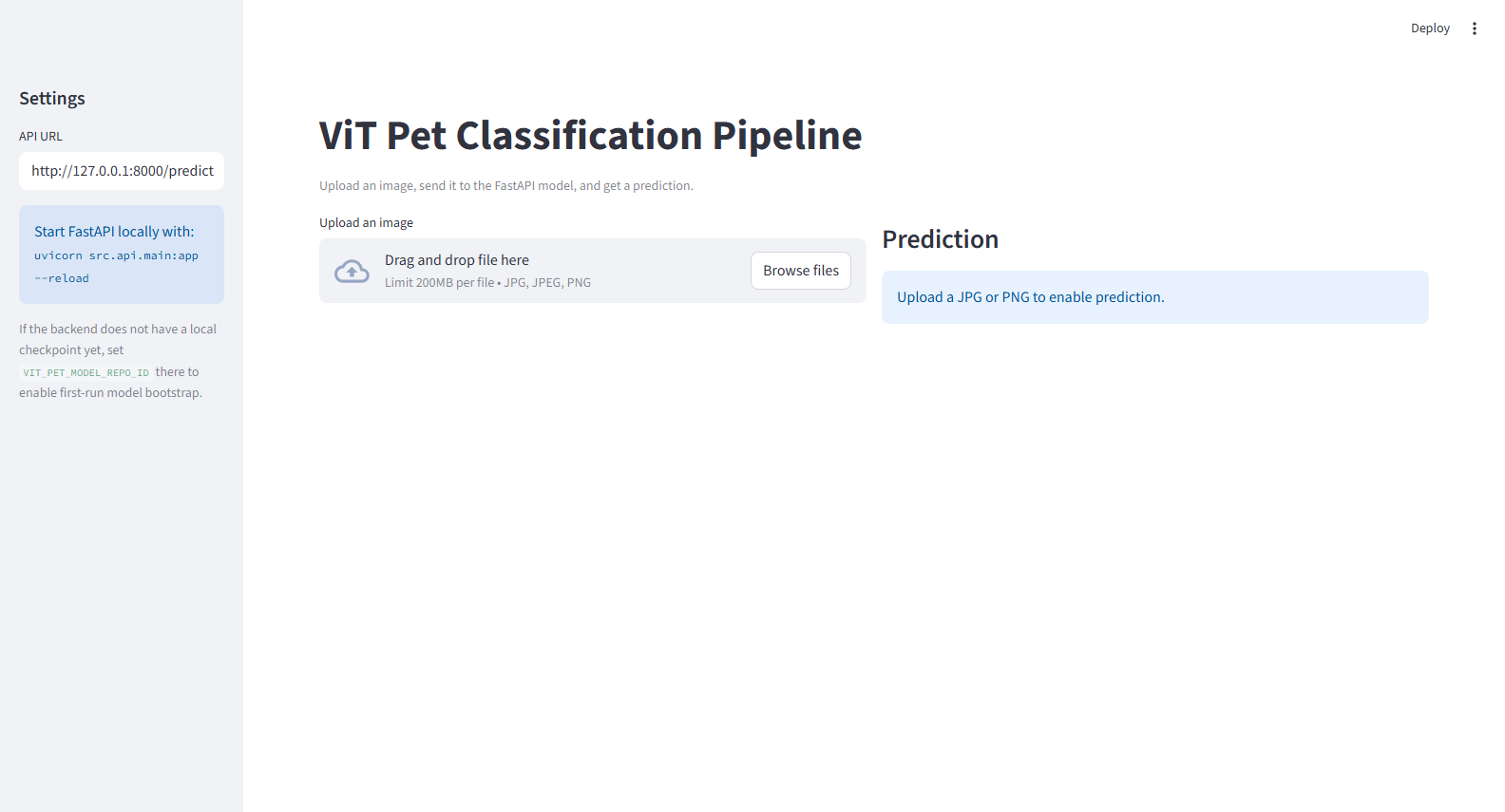
Public supporting ML-delivery repository with a sanitized UI screenshot, CI, tests, Oxford-IIIT preparation script, release-candidate workflow script, training metadata, evaluation artifact writer, release manifest checksums, a FastAPI health endpoint that can be reviewed without loading model weights, and explicit artifact boundaries for datasets and checkpoints.

Architecture / workflow

  • Oxford-IIIT preparation script writes a binary cats-vs-dogs labels file and dataset manifest.
  • Training and evaluation scripts write metadata, eval JSON, confusion matrix, and Markdown report artifacts.
  • CLI prediction gives a lightweight local inference path.
  • FastAPI exposes inference behind a service boundary.
  • Streamlit provides a reviewer-friendly UI for visual inspection.

Next steps

  • Treat the RC50 run as workflow evidence only until a stronger evaluation split and model card justify public model-quality presentation.
  • Add a real prediction screenshot only after a project-owned checkpoint is safe to demonstrate.
  • Keep model-bootstrap behavior and artifact boundaries visible in the docs.
  • Keep third-party branding and heavy artifacts out of public assets.
ViT Pet Classification Pipeline Streamlit UI without third-party branding