ADArsenios DiamantakosApplied AI Implementation & Software Engineering
Back to project library

Operational implementation planning

OpsForge Planning Workspace

Public RepoPlanning WorkspaceDeterministic CoreDocker

CaseForge now serves as the public planning module behind the OpsForge direction. It uses planner, architect, evaluator, and delivery-path stages to produce reviewable implementation dossiers through a CLI, local web app, and HTTP API. Deterministic mode is the default; optional model refinement stays secondary to the reproducible planning pipeline.

What it proves

Turns rough operational implementation briefs into handover-ready planning artifacts before build work starts.

What it proves

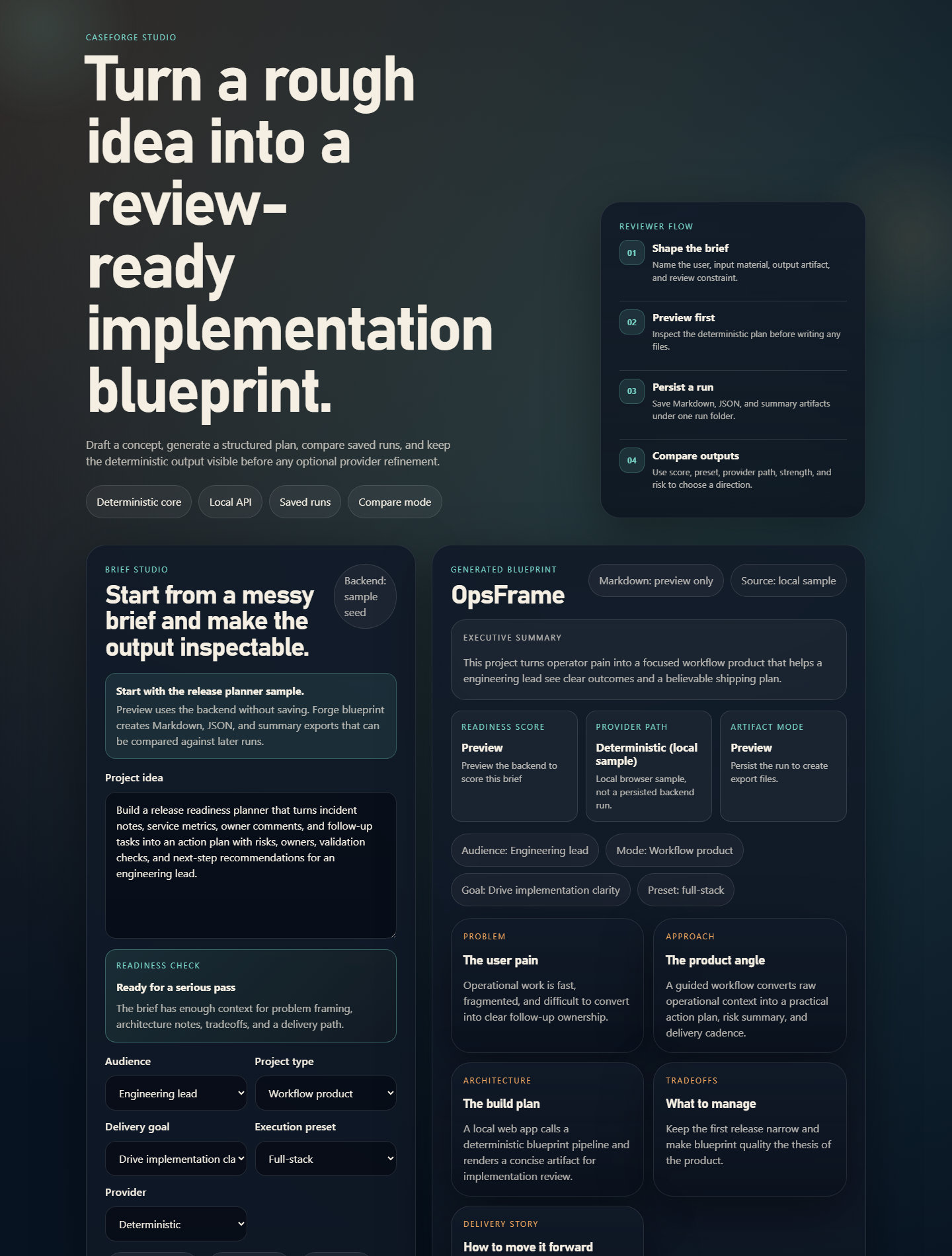
Shows implementation framing, architecture notes, test plans, risk registers, deployment checklists, saved-run comparison, and deterministic output boundaries.
Impact

  • Turns rough operational implementation briefs into handover-ready planning artifacts before build work starts.
  • Shows implementation framing, architecture notes, test plans, risk registers, deployment checklists, saved-run comparison, and deterministic output boundaries.

Problem

Rough product ideas often jump straight into code without enough implementation structure. CaseForge turns those ideas into reviewable planning artifacts before build work starts.

Approach

The project runs a deterministic planning pipeline that separates product framing, architecture notes, evaluation, and delivery-path output. Optional model refinement can improve wording, but the core workflow remains runnable without it.

Current status

Public repository with deterministic examples, a one-command reviewer demo script, local UI/API demo paths, tests, an OpsForge module contract, export manifests, saved-run comparison, and release notes. It is the public planning-workspace proof for the wider OpsForge Suite direction.

Architecture / workflow

  • CLI and local web surfaces share the same dossier-generation pipeline.
  • Planner, architect, evaluator, and delivery-path stages produce structured sections.
  • Saved runs and comparison views make outputs reviewable across iterations.
  • HTTP endpoints expose the same deterministic core for local demos.

Next steps

  • Keep local UI screenshots current as the reviewer flow changes.
  • Add a short sample dossier excerpt that is safe to show on the site.
  • Keep optional model refinement clearly separated from deterministic output.
CaseForge Studio local web app showing a generated implementation blueprint
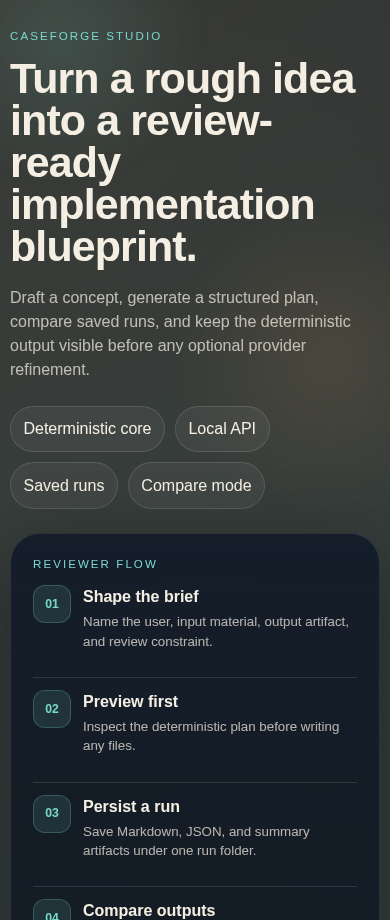
CaseForge Studio mobile layout for the local implementation blueprint workspace